International Journal of Human Computer Studies
The International Journal of Human Computer Studies (IJHCS) has invited me into their editorial board. I hope to be able to serve the community with my efforts. IJHCS is only second to Human-Computer Interaction in terms of impact factor according to the Journal Citation Report. Below you find the latest ranking:
| Journal | Impact Factor |
|---|---|
| HUM-COMPUT INTERACT | 6.190 |
| INT J HUM-COMPUT ST | 2.380 |
| USER MODEL USER-ADAP | 2.345 |
| INTERACT COMPUT | 1.698 |
| HUM FACTORS | 1.458 |
| ACM T COMPUT-HUM INT | 1.194 |
| BEHAV INFORM TECHNOL | 0.767 |
| INTERACT STUD | 0.776 |
| INT J HUM-COMPUT INT | 0.587 |
Ranking of HCI Journals by Impact Factor
Read More
Visualization of the General Terms used at the CHI conference
Niko Vegt visualized what general terms have been used to describe the CHI publications. His full report is also available. The term “Theory” appears to have the strongest fluctuations. “Human Factors” and “Design” appear to be pretty stable and “Experimentation” remains one of the least frequently used term.
Read More
Statistics on the scientific staff members of the Eindhoven University of Technology (TU/e)
Me and a colleague from another department recently wondered if there were any structural differences between the nine departments at the TU/e. So I collected the information from out website as of today. The table below shows that Industrial Design is by far the smallest department and that we have the fewest associate professors (3). Biomedical Engineering has almost the same number of professors, but they have more than double the number of PhD students and teachers. Mechanical engineering does only list three teachers, which is well below average. The complete data is available.
| faculty | # | phd | pd | teach. | professor | |||
|---|---|---|---|---|---|---|---|---|
| # | assist. | assoc. | full | |||||
| industrial design | 132 | 46 | 3 | 47 | 36 | 61.1% | 8.3% | 30.6% |
| biomedical engineering | 286 | 108 | 26 | 110 | 42 | 35.7% | 16.7% | 47.6% |
| physics | 277 | 163 | 32 | 19 | 63 | 31.7% | 27.0% | 41.3% |
| architecture | 241 | 75 | 3 | 77 | 86 | 51.2% | 19.8% | 29.1% |
| chemical engineering | 351 | 169 | 64 | 56 | 62 | 29.0% | 29.0% | 41.9% |
| mechanical engineering | 251 | 142 | 31 | 3 | 75 | 42.7% | 22.7% | 34.7% |
| electrical engineering | 325 | 137 | 39 | 63 | 86 | 38.4% | 19.8% | 41.9% |
| indust, eng. & inov. sci. | 238 | 73 | 9 | 50 | 106 | 55.7% | 16.0% | 28.3% |
| computer science | 329 | 116 | 43 | 58 | 112 | 55.4% | 13.4% | 31.3% |
Read More
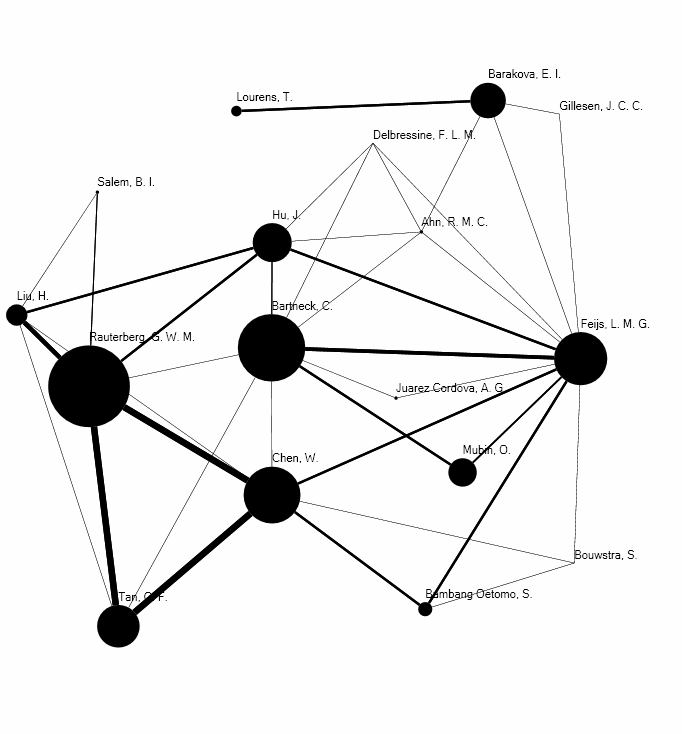
Collaboration within the Designed Intelligence Group in the Year 2009
We performed a co-authorship analysis of the publications from the Designed Intelligence Group at the Department of Industrial Design at the Eindhoven University of Technology. The data was gathered from the Metis system. The graph only shows publications from the year 2009 which were authored from at least two DI group members. The size of the circle indicates the total number of publications and the width of the lines indicates the number of co-authored papers. The graph visualizes my collaboration with the members of the DI group in 2009.
Read More


I am an Associate Professor (Reader) at the HIT Lab NZ, University of Canterbury.