Don Rowe wrote an excellent article about Jürgen’s and my work and ask the question, are you also just a Truman? Valid and important point. Have a read of the full article.

University of Canterbury, New Zealand

Don Rowe wrote an excellent article about Jürgen’s and my work and ask the question, are you also just a Truman? Valid and important point. Have a read of the full article.
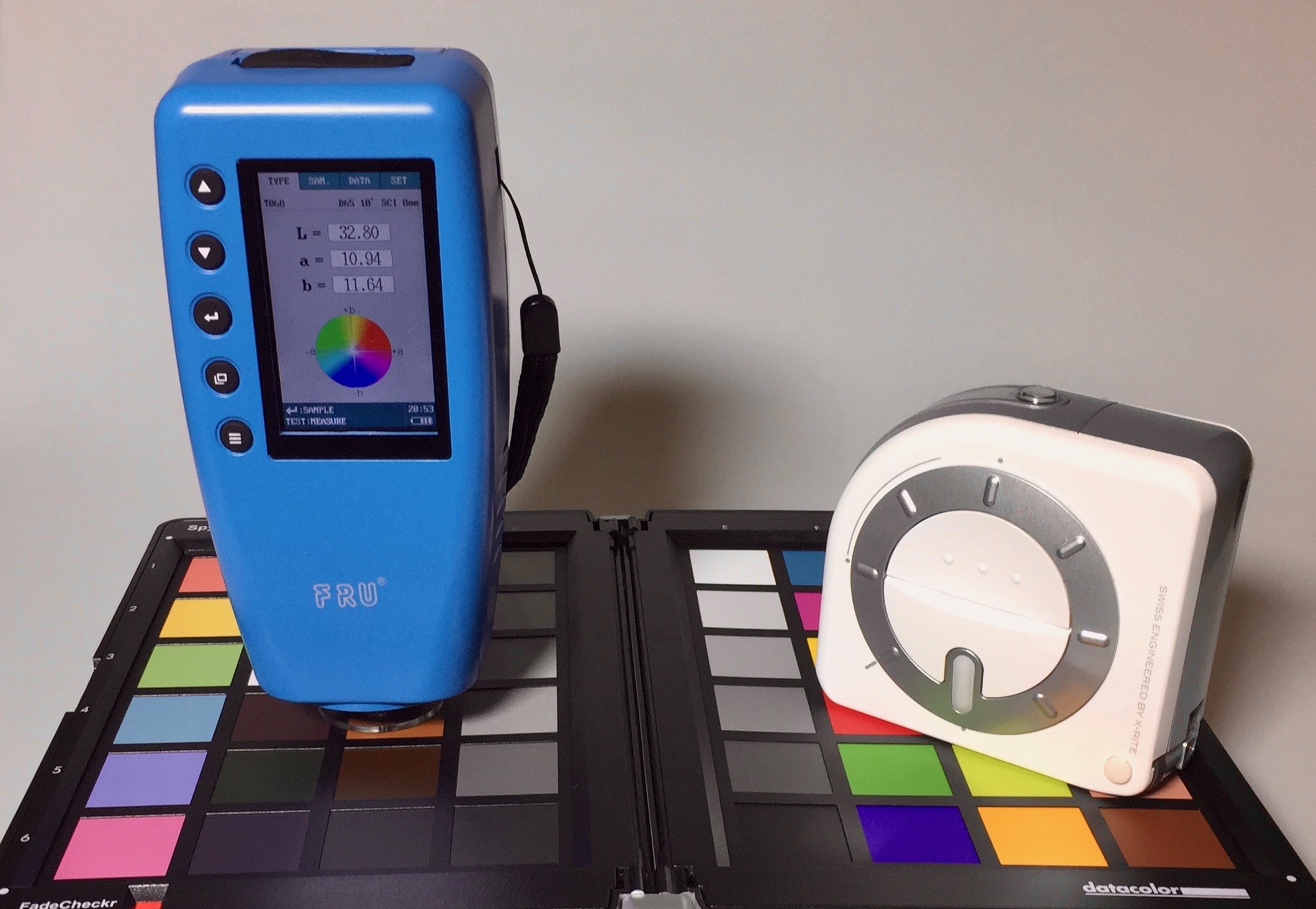
Review of the measurement accuracy of the ColorMunki Design and the FRU WR-10.
I am working on a colour project and had purchased the WR10 colorimeter to complement my long serving work horse, the X-Rite Color Munki Design. My ColorMunki is already several years old and I was concerned that its accuracy might have declined. When I measured several hundreds of samples, I noticed that both colorimeters gave me considerably different LAB values.
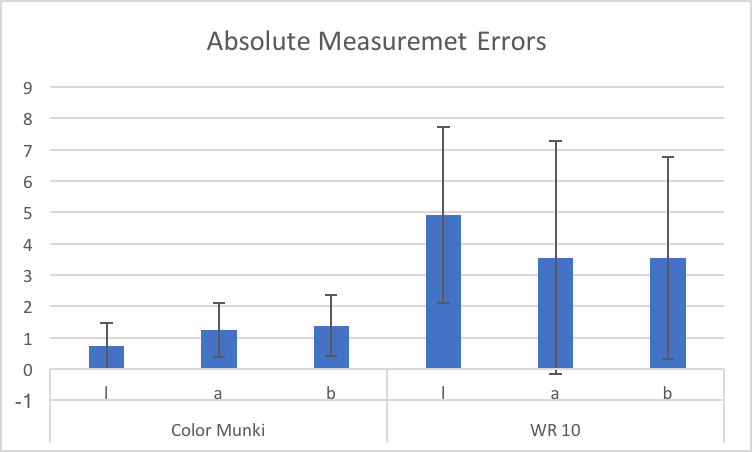
To determine which device was closer to the truth I measured the 48 defined colours of Datacolor’s SpyderCHECKR 48. I calculated the absolute error both devices made. The results of a paired-sample t-test showed that the ColorMunki is producing significantly less measurement errors on L (t(47)=-9.229, p<0.001), L (t(47)=-4.590, p<0.001) and L (t(47)=-4.871, p<0.001). However, both devices measure colours that are significantly different from the target colour of the SpyderCheckr card on all three measurements. Figure 1 shows the means and standard deviation for all measurement errors.
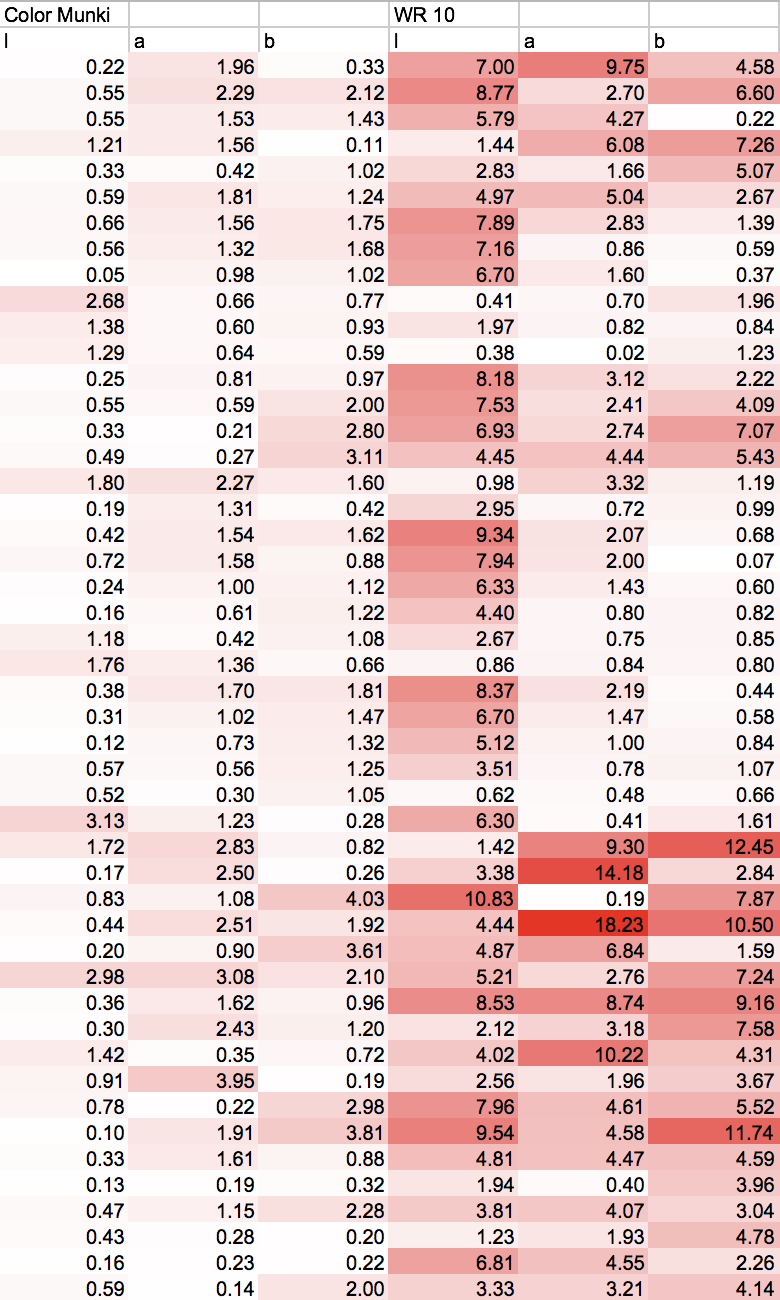
There does seem to be some structure in the errors that WR-10 is producing. Have a look at the heat map (Figure 2). The data for my little experiment is available at the Open Science Framework (DOI: 10.17605/OSF.IO/UWEFD).
Although both devices show some significant deviation from the original, it is not far off from what can be expected of devices in this price range. The ColorMunki Design produces significantly better results than the FRU’s WR-10QC.
Below you find the Datacolor SpyderCheckr 48 definition of patches in different color spaces, such as LAB, sRBG and AdobeRGB. Datacolor offers a lousy bitmap of the values which are difficult to read and impossible to use in a structured way. So there you go, a table of all the values that this color chart is suppose to represent:
| Lab | sRGB | Adobe RGB | |||||||||
|---|---|---|---|---|---|---|---|---|---|---|---|
| Number | Patch | Name | L | A | B | R | G | B | R | G | B |
| 1 | 1A | Low Sat. Red | 61.35 | 34.81 | 18.38 | 210 | 121 | 117 | 189 | 121 | 117 |
| 2 | 2A | Low Sat. Yellow | 75.5 | 5.84 | 50.42 | 216 | 179 | 90 | 205 | 178 | 96 |
| 3 | 3A | Low Sat. Green | 66.82 | -25.1 | 23.47 | 127 | 175 | 120 | 141 | 174 | 122 |
| 4 | 4A | Low Sat. Cyan | 60.53 | -22.6 | -20.4 | 66 | 157 | 179 | 103 | 156 | 177 |
| 5 | 5A | Low Sat. Blue | 59.66 | -2.03 | -28.46 | 116 | 147 | 194 | 125 | 146 | 191 |
| 6 | 6A | Low Sat. Magenta | 59.15 | 30.83 | -5.72 | 190 | 121 | 154 | 172 | 120 | 151 |
| 7 | 1B | 10% Red Tint | 82.68 | 5.03 | 3.02 | 218 | 203 | 201 | 213 | 202 | 200 |
| 8 | 2B | 10% Green Tint | 82.25 | -2.42 | 3.78 | 203 | 205 | 196 | 202 | 204 | 195 |
| 9 | 3B | 10% Blue Unit | 82.29 | 2.2 | -2.04 | 206 | 203 | 208 | 204 | 201 | 206 |
| 10 | 4B | 90% Red Tone | 24.89 | 4.43 | 0.78 | 66 | 57 | 58 | 66 | 60 | 60 |
| 11 | 5B | 90% Green Tone | 25.16 | -3.88 | 2.13 | 54 | 61 | 56 | 59 | 63 | 59 |
| 12 | 6B | 90% Blue Tone | 26.13 | 2.61 | -5.03 | 63 | 60 | 69 | 65 | 63 | 71 |
| 13 | 1C | Lightest Skin | 85.42 | 9.41 | 14.49 | 237 | 206 | 186 | 225 | 202 | 183 |
| 14 | 2C | Lighter Skin | 74.28 | 9.05 | 27.21 | 211 | 175 | 133 | 200 | 174 | 134 |
| 15 | 3C | Moderate Skin | 64.57 | 12.39 | 37.24 | 193 | 149 | 91 | 180 | 148 | 95 |
| 16 | 4C | Medium Skin | 44.49 | 17.23 | 26.24 | 139 | 93 | 61 | 127 | 93 | 65 |
| 17 | SC | Deep Skin | 25.29 | 7.95 | 8.87 | 74 | 55 | 46 | 71 | 58 | 50 |
| 18 | SC | 95% Gray | 22.67 | 2.11 | -1.1 | 57 | 54 | 56 | 59 | 57 | 59 |
| 19 | 1D | 5% Gray | 92.72 | 1.89 | 2.76 | 241 | 233 | 229 | 238 | 233 | 229 |
| 20 | 2D | 10% gray | 88.85 | 1.59 | 2.27 | 229 | 222 | 220 | 226 | 221 | 219 |
| 21 | 3D | 30% Gray | 73.42 | 0.99 | 1.89 | 182 | 178 | 176 | 180 | 177 | 174 |
| 22 | 4D | 50% Gray | 57.15 | 0.57 | 1.19 | 139 | 136 | 135 | 137 | 135 | 134 |
| 23 | 5D | 70% Gray | 41.57 | 0.24 | 1.45 | 100 | 99 | 97 | 99 | 99 | 98 |
| 24 | 6D | 90% Gray | 25.65 | 1.24 | 0.05 | 63 | 61 | 62 | 65 | 63 | 64 |
| 25 | 1E | Card White | 96.04 | 2.16 | 2.6 | 249 | 242 | 238 | 247 | 242 | 237 |
| 26 | 2E | 20% Gray | 80.44 | 1.17 | 2.05 | 202 | 198 | 195 | 199 | 196 | 193 |
| 27 | 3E | 40% Gray | 65.52 | 0.69 | 1.86 | 161 | 157 | 154 | 158 | 156 | 153 |
| 28 | 4E | 60% Gray | 49.62 | 0.58 | 1.56 | 122 | 118 | 116 | 120 | 118 | 115 |
| 29 | 5E | 80% Gray | 33.55 | 0.35 | 1.4 | 80 | 80 | 78 | 81 | 81 | 79 |
| 30 | 6E | Card Black | 16.91 | 1.43 | -0.81 | 43 | 41 | 43 | 46 | 46 | 47 |
| 31 | 1F | Primary Cyan | 47.12 | -32.5 | -28.75 | 0 | 127 | 159 | 39 | 126 | 157 |
| 32 | 2F | Primary Magenta | 50.49 | 53.45 | -13.55 | 192 | 75 | 145 | 167 | 76 | 141 |
| 33 | 3F | Primary Yellow | 83.61 | 3.36 | 87.02 | 245 | 205 | 0 | 234 | 204 | 37 |
| 34 | 4F | Primary Red | 41.05 | 60.75 | 31.17 | 186 | 26 | 51 | 159 | 32 | 53 |
| 35 | 5F | Primary Green | 54.14 | -40.8 | 34.75 | 57 | 146 | 64 | 94 | 145 | 71 |
| 36 | 6F | Primary Blue | 24.75 | 13.78 | -49.48 | 25 | 55 | 135 | 41 | 58 | 132 |
| 37 | 1G | Primary Orange | 60.94 | 38.21 | 61.31 | 222 | 118 | 32 | 196 | 117 | 44 |
| 38 | 2G | Blueprint | 37.8 | 7.3 | -43.04 | 99 | 86 | 96 | 70 | 89 | 156 |
| 39 | 3G | Pink | 49.81 | 48.5 | 15.76 | 195 | 79 | 95 | 170 | 80 | 94 |
| 40 | 4G | Violet | 28.88 | 19.36 | -24.48 | 83 | 58 | 106 | 78 | 61 | 104 |
| 41 | 5G | Apple Green | 72.45 | -23.6 | 60.47 | 157 | 188 | 54 | 165 | 186 | 69 |
| 42 | 6G | Sunflower | 71.65 | 23.74 | 72.28 | 236 | 158 | 25 | 218 | 157 | 46 |
| 43 | 1H | Aqua | 70.19 | -31.9 | 1.98 | 98 | 187 | 166 | 130 | 186 | 166 |
| 44 | 2H | Lavender | 54.38 | 8.84 | -25.71 | 126 | 125 | 174 | 125 | 124 | 171 |
| 45 | 3H | Evergreen | 42.03 | -15.8 | 22.93 | 82 | 106 | 60 | 90 | 106 | 65 |
| 46 | 4H | Steel Blue | 48.82 | -5.11 | -23.08 | 87 | 120 | 155 | 98 | 119 | 152 |
| 47 | SH | Classic Light Skin | 65.1 | 18.14 | 18.68 | 197 | 145 | 125 | 183 | 144 | 125 |
| 48 | 6H | Classic Dark Skin | 36.13 | 14.15 | 15.78 | 112 | 76 | 60 | 103 | 77 | 63 |
The Insta360 Adobe Plugin is not working.
I recently recorded a lecture I gave in Stuttgart using the latest Insta360 One camera. Since it is very difficult to stop an academic from talking the whole presentation took nearly one hour. The camera divided the recoding into several files, each around 4 GB. This is probably because they wanted to be compatible with the old FAT32 file system.
Their 360 Editing Software allows you to convert their proprietary INSV files into MP4 files and they even have a batch processing option. But the software cannot merge multiple videos into one, which I desperately needed.
Insta360 is also offering a plugin for Adobe Premiere and After Effects. After installing the plugin I was able to import the INSV files into Premiere, but the image of one of the cameras was upside down. I contacted their technical support and they explained to me that the plugin is currently not working.
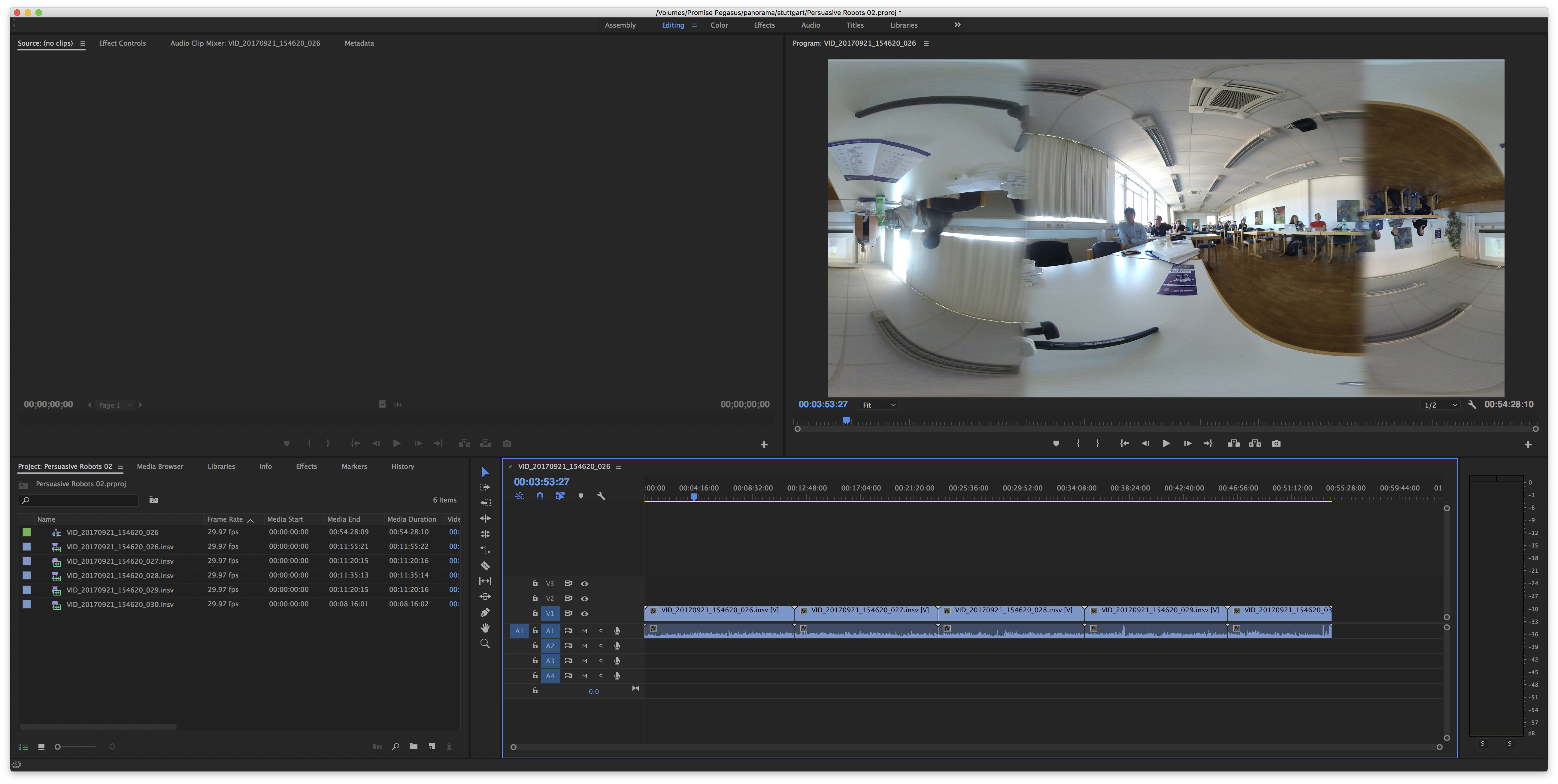
I ended up having to convert all the INSV files to MP4 first and then editing them into one movie in Premiere. I have to admit that this workflow is rather inconvenient and I hope that Insta360 will either enable their editing software to merge movies or that they get their Adobe plugin working again. This seems another example of Banana Technology, it ripens at the user.
My talk on Persuasive Robots at the Emotional Machines Conference.
I was invited to give a talk at the Interdisciplinary Conference on Emotional Machines in Stuttgart on September 21st, 2017. My talk focused mainly on the work I did in collaboration with Jürgen Brandstetter (doi: 10.1145/2909824.3020257, doi: 10.1177/0261927X15584682, doi: 10.1109/IROS.2014.6942730). My main argument was that the number of robots in our society will increase dramatically and robots will participate in the formation of our language. Through their influence on our language they will be able to nudge our valence related to certain terms. Moreover, it will only take 10% of us to own a robot for them to dominate the development of our language.
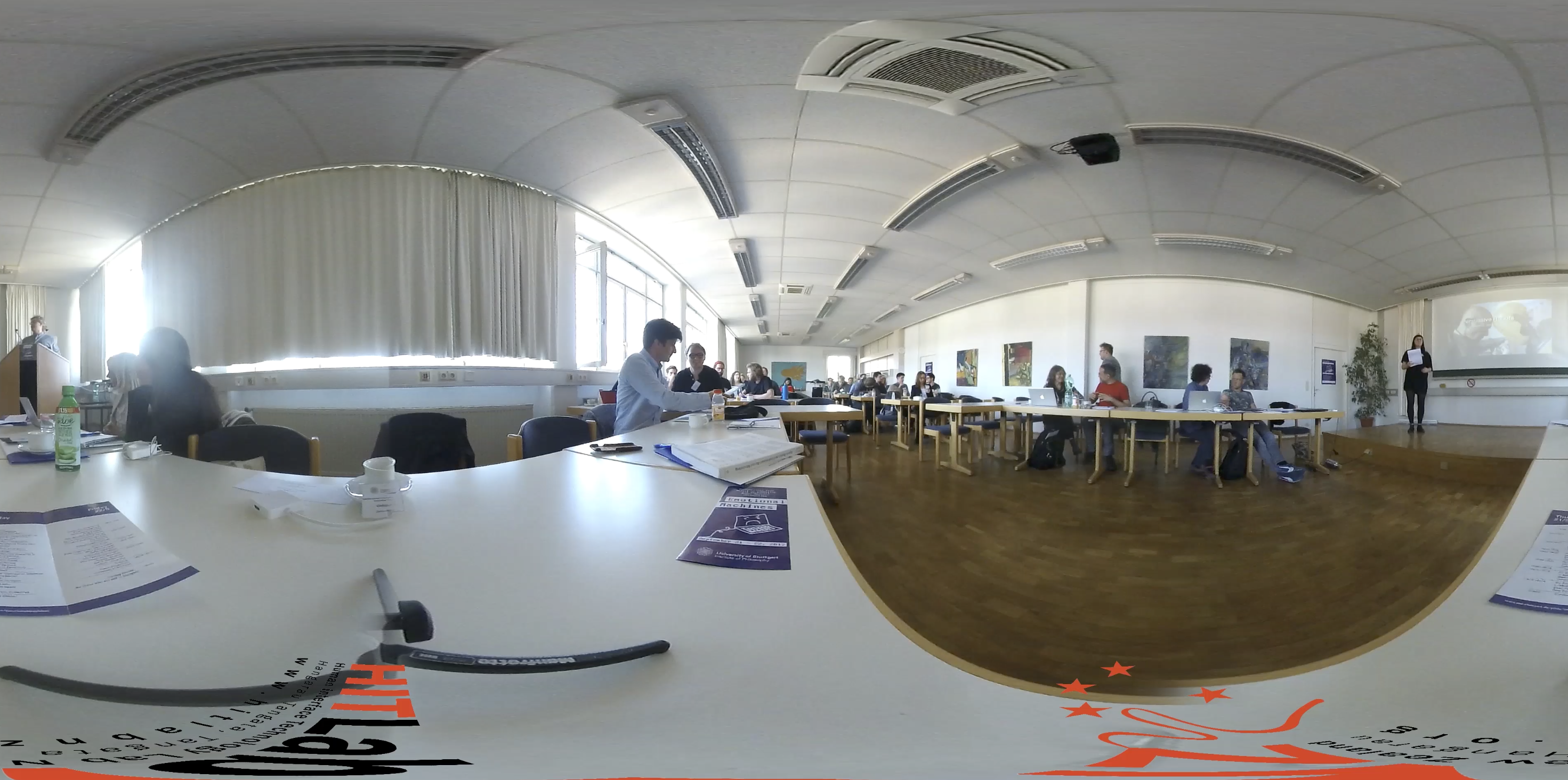
This is also the first time I used a 360 degree camera to record a talk. This technology becomes particularly useful when following the discussion between the speaker and the audience. YouTube’s 360 video feature does not work in all web browser (e.g. it does not work with Safari). Chrome and Firefox should be fine.